

Exclusive: An Inside Look at Our Eileen Investigation
How we uncovered the tragic tale of Eileen Mihich, and what it means for the physician-assisted suicide debate

It’s a strange thing, scrolling through the phone of a dead person. Reading their messages, listening to voicemails that will never get a call back, flitting between apps and Safari windows like that person must have done tens of thousands of times before they passed.
Last July was the first time I’ve ever had to do that. I found myself in the suburbs of Portland, Oregon with Frank Barnes, our Director of Media, after months of investigating a story that I initially doubted. But that morning in Beaverton, it was as clear as that morning’s blue Oregon sky – Eileen Mihich’s death was real, and Washington’s Death with Dignity law was to blame.
*****
March of 2025 was busy at Aging with Dignity – February saw the long-overdue rebrand of our website, and we had just announced an ambitious research endeavor, Assisted Suicide Watch. On top of our usual work, our team was hustling to field media requests and troubleshoot website bugs, all while operating shorthanded as I searched for a new office manager.
On the morning of Monday, March 24th, I was jolted from this frenzy with the notification of a “Contact Us” submission from a woman named Veronica. “I am reaching out to you with a broken heart,” it began. The message that followed read almost as a caricature of what opponents of physician-assisted suicide (PAS) have warned. A mentally ill young woman without a terminal disease skated past Washington’s guardrails and was found dead in a hotel room, an empty bottle of PAS pills by her side. I am sorry to say, my first reaction was concern that this was some kind of catfishing operation from Compassion & Choices or Death with Dignity.
Nevertheless, I asked if Veronica could share her story over a video call. She agreed, we picked a date, and in the runup I carefully read through Washington’s state law and health codes. Several days later, Veronica and I spoke, joined by her daughter, Sarah. It immediately was clear that these women were beset by a range of negative emotions and were genuinely upset; they sounded truthful.
As for their story, Veronica and Sarah claimed that Eileen Mihich (their niece and cousin, respectively), a bubbly and goofy, but mentally ill woman had somehow beaten Washington’s PAS system in a way that I, and others who study PAS for a living, had never thought possible. Eileen had directly contacted a pharmacy in Washington under the name of a real-life physician, used that physician’s publicly available information to fraudulently fill out a prescription for DDMAPh (the poisonous cocktail prescribed for PAS), and then picked it up herself directly from the pharmacy.
I was baffled. How did Eileen pull this off? Her life was in complete disarray, yet she figured this out all by herself. Did someone help her, or at least inform her of this niche workaround? Was the doctor she impersonated in on it? Was the pharmacist? Could this be the tip of an iceberg of abuse and fraud? So many questions coursed through my mind, but one thing was certain – if what Veronica and Sarah conveyed was true, the world needed to know.
Our team at Aging with Dignity started digging. Immediately after the call, Sarah shared a trove of documents with us. Screenshots of Eileen’s emails, text messages, and phone logs between her and Michael Jones, the owner of Northwest Pharmaceutical and Compounding in Mill Creek, WA, the pharmacy that prescribed her the poison. Photos of the empty bottle of DDMAPh, the signed prescription form from Northwest Pharmaceutical, and instructions from End of Life Washinton on how to consume the poison, complete with macabre and banal steps like, “Mix and consume the lethal medication.” Particularly difficult to stomach were DVDs of Mr. Rogers’ Neighborhood and Matilda found at the scene of her death which, along with some recent makeup and gym membership purchases, were evidence to Sarah and Veronica that Eileen was ambivalent about taking her own life.
Back at Aging with Dignity, we pored over the California, Oregon, and Washington statutes to search for any criminal law violations. I called several of my doctor friends and peppered them with questions. They informed me that falsifying a prescription for a basic item like skin cream probably isn’t hard to pull off, but controlled substances were a different matter. Drugs like OxyContin can only be fulfilled through an electronic request from physician to pharmacist. Yet I was stunned to learn that in Washington, and indeed in every state where PAS is legal, the rules don’t apply to DDMAPh, a pill with sixty times the killing power of a lethal dose of morphine. It can be fulfilled by hand delivery, mail, fax, and even can be mailed to recipients, like it’s Ozempic.
Sarah had filed police reports in Portland, Mill Creek, and San Luis Obispo where the impersonated doctor resided, and the prospects of all three cases were unclear. And it increasingly looked like the impersonated doctor was as surprised by this as we were. The pharmacist in Washington didn’t look like he was operating an underground referral racket. So, we gradually ruled out the likelihood that criminal charges could be brought. A civil lawsuit also looked impracticable due to Washington’s “good faith provision” which offers nearly blanket protection for malpractice related to PAS.
But Veronica and Sarah don’t give up easily. Before they had reached out to us, these tenacious, inspiring women had been ghosted by various local media outlets across the Pacific Northwest. Veronica also contacted Death with Dignity, one of the leading members of the Big Death national coalition, and was ignored; instead, she was added to their fundraising list! Ironically that is how she found us. One of their March fundraising emails, wailed: “A well-funded group called Assisted Suicide Watchdog [their words, though I like it]… has formed… The opposition is sneaky, and their funding is massive.” Veronica later told me that she thought, “Well, if you [Death with Dignity] won’t help us, maybe these guys will.”
The impossibility of a lawsuit or criminal charges wasn’t going to slow Veronica or Sarah down, They asked us if we could share their story with the American public.
I still hadn’t shaken my doubts when Frank and I touched down in Portland several months later. Could we have missed something? After a night of shuteye at a Marriott in the heart of Portland’s decrepit downtown, we hopped in our Rav-4 rental and picked up C stands, lights, sandbags, and a tripod from a local gear shop, and then make our way to Veronica’s address in Beaverton.
As we pulled up to what Veronica called her “swanky digs,” I was struck by the lopsided nature of Veronica and Sarah’s struggle for justice. This diminutive jumble of dusty garden style apartment complex off Route 30 felt isolated compared to the tens of millions of dollars powering the legalized suicide machine, embodied by the dark and imposing tower that houses Compassion & Choices, a site I visited the next day in Portland (they didn’t let me in).
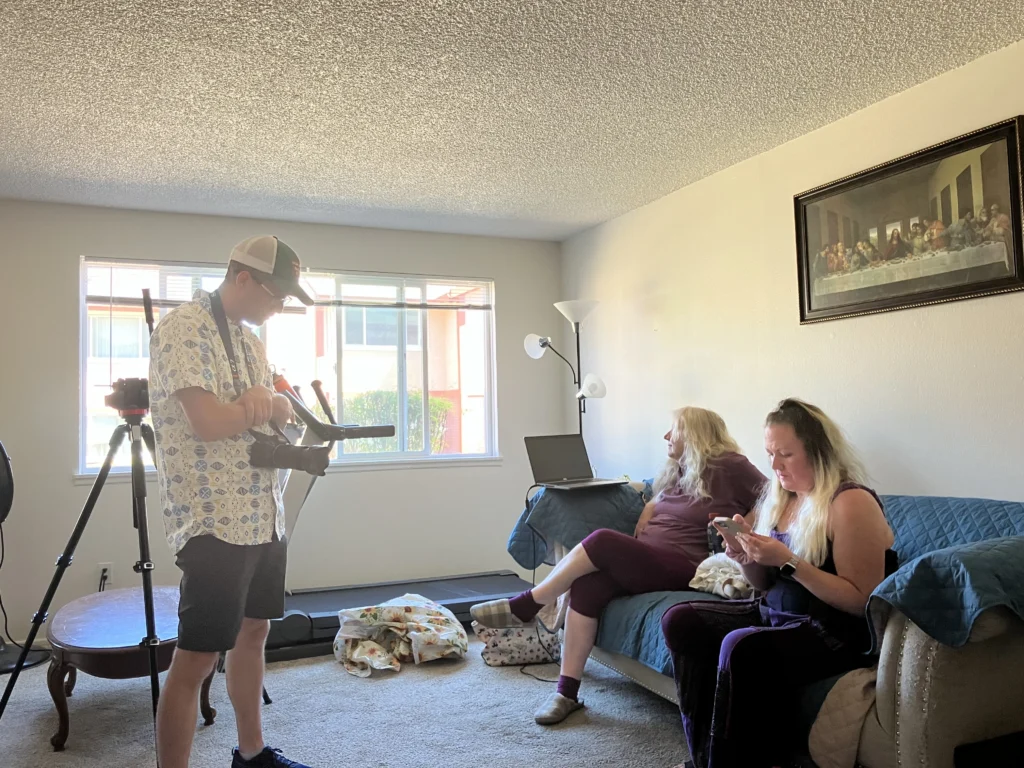
Frank and I hauled our equipment to Veronica’s door, knocked, and were greeted by Veronica’s earnest, smiling, but anxious face. With a spread of iced coffee, donuts, “local cheese” (I suppose Tillamook cheddar is local when you’re in Oregon), sliced apples, and other snacks to fuel us, Frank got to work on lighting, setup, and sound. While we waited, Veronica walked me through the array of family photos on the wall and then directed me toward a table in the kitchen covered with artifacts from Eileen’s life. I remember feeling a chill looking at the prescription that cost Eileen her life.
Once the lights were up and the cameras were rolling, I spent well over an hour interviewing Veronica. When we had finished, Sarah arrived, and she passed on more memorabilia from Eileen. Among these was the key to so much of what we found – Eileen’s phone. Sarah knew Eileen’s password, and while we couldn’t access a few of her social media apps, we otherwise had free reign with this treasure trove. My empathy for Eileen and what she went through grew immeasurably that day. I felt like I knew her, and I mourned her loss.
At the end of the day, Frank and I packed up to head back to the hotel; I to see two cousins who lived in the area, and Frank to doggedly capture B-roll footage all across the city, including a gamut where he straddled the median of a bridge and had an intercom yell at him to go back to the sidewalk (you can see a shot from that bridge at this mark in the video). I remember playing with my cousin Meredith’s two children in a daze knowing that such idyllic joy could exist in the heart of a city that spawned, and continues to influence, this nationwide embrace and normalization of suicide.
The next day we drove to Seattle. On the way we visited the Washington Department of Health in Olympia, met with a good friend and colleague, Dr. Sharon Quick, visited the two phony addresses in Eileen’s DwD application (neither exists) and finished our day at Northwest Pharmaceutical and Compounding, the pharmacy that provided Eileen this poison, in violation of state law.
The darkest moment of our fact-finding journey came in an unremarkable suburban neighborhood outside Seattle. Eileen had been in close contact with A Sacred Passing, a death doula service that facilitates peoples’ suicides by giving them a physical location to perform the deed. Or as they describe themselves, “A community deathcare education and care nonprofit rooted in antiracist learning, autonomy, care and mutual aid.” Eileen had spoken with them on the phone multiple times in the weeks leading up to her death, once for 50 minutes, and it appeared that they had coordinated some of her care. Frank and I wanted shots of the building’s exterior. We had expected an office building; instead, we found a charming street of single-family homes, yards strewn with children’s toys. One foreboding house stood in their midst, its sides enveloped by shrubs and its front obscured by a prodigious tree planted by the door, whose branches reached over the covered portico and up to the roof itself. We didn’t even need the house number; it was obvious that this was a destination for death. As we learned later, A Sacred Passing has claimed over 300 lives under its roof. The car was quiet as we pulled away.
The next four months were consumed by preparations for our video’s release. We tweaked, tightened, rearranged, re-tweaked, and re-tightened the video. Before our visit to the Pacific Northwest, I had reached out to Elizabeth Bruenig, a reporter for The Atlantic who had written compellingly on a variety of sensitive issues like the Me Too movement, Cardinal Theodore McCarrick, campus sexual assault, and lethal injection. The Atlantic reaches millions of readers and I felt she could contribute investigative reporting skills that we didn’t have. We believed that we should only release the video once her piece was close to running. We also needed the official autopsy and toxicology reports to be published. By mid-December, we were ready.
More than 300,000 views and many comments later, our efforts feel bittersweet. This is certainly the most resonant advocacy campaign that Aging with Dignity has managed in many years. And indeed, the media attention and comments Eileen’s story engendered are nothing short of inspiring. And yet, Eileen isn’t coming back, and these laws aren’t changing anytime soon. In fact, soon after our video was published, Governor Kathy Hochul brought suicide-affirming care to the Empire State. What happened to Eileen can happen to anyone in 13 states in our country.
Shortly after they first came in contact with us, Sarah and Veronica received word that the Washington Department of Health was investigating the case for misconduct. It has been one year and Sarah and Veronica have heard nothing. The state of Washington doesn’t seem willing to come clean on what happened to Eileen.
On our final night in Portland, I stood alone on Hawthorne Bridge and reflected on the events of the previous two days. I wondered what would passersby do if I clambered onto the ledge and poised myself to jump – would anyone run to help?
I thought then as I do now – yes, someone would help.
But what if I did what Eileen did? Would the system protect me from myself and help me live and get the assistance I needed?
A year after embarking on this journey, I can say with confidence and chagrin – no. That is why we at Aging with Dignity will continue to fight for a change that helps people live instead of helping them die.
(The views expressed herein are those of the author and do not necessarily reflect the views of Aging with Dignity and/or its Board of Directors.)