
Does Auschwitz Warn Us About AI?
Pope Leo's encyclical on AI meets John Paul II's speech at Auschwitz
June 4, 2026
By Jim Towey
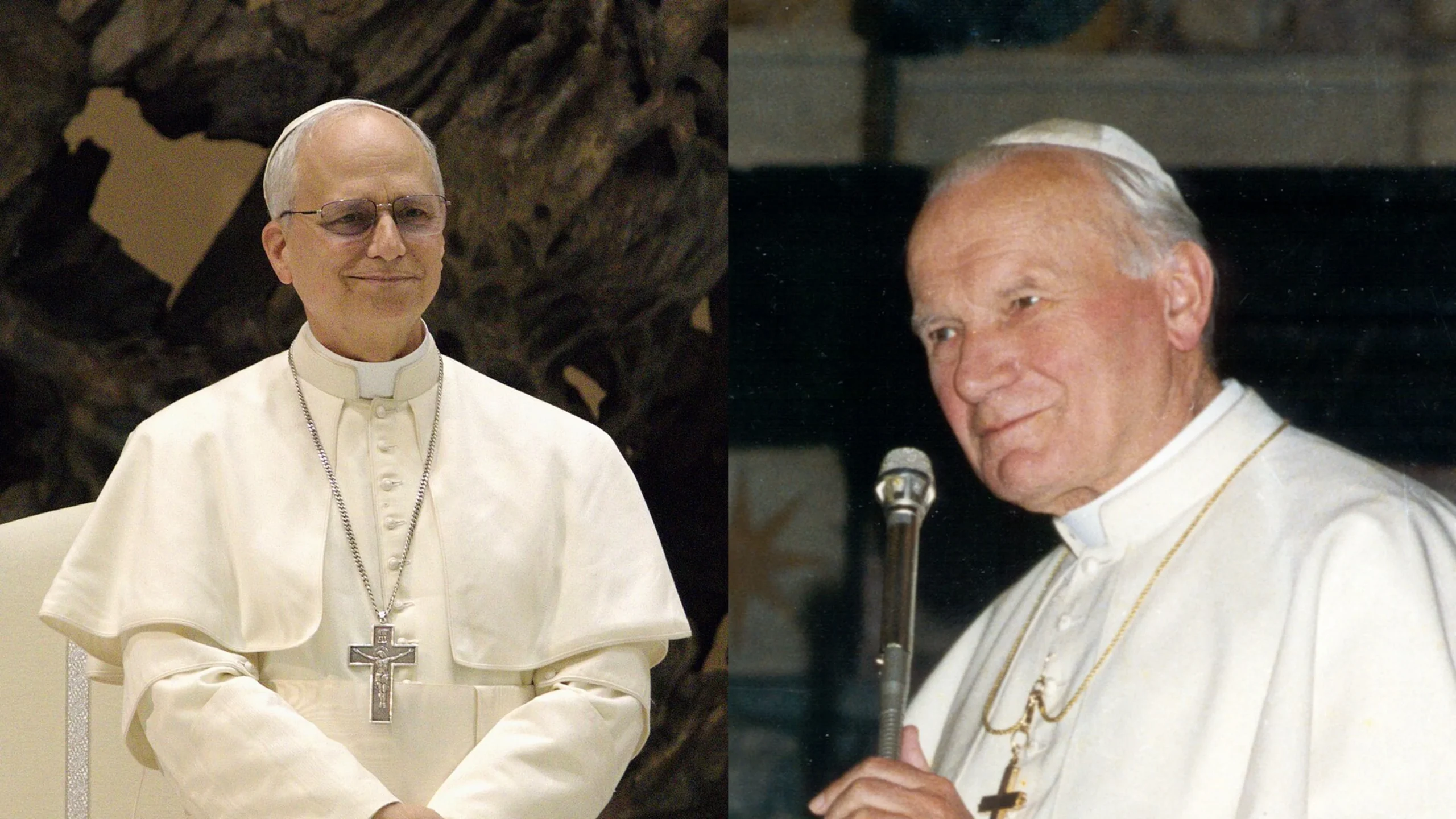
Pope Leo XIV’s recent encyclical on artificial intelligence has become a Rorschach test of sorts. Some see it as a warning about the existential threat that AI poses to humanity, particularly through its application in times of war. Others say he simply laid out the pros and cons of this new technology and urged its responsible use.
Any reader of this blog knows that I have spent the last five years warning about AI, decrying the recklessness of its Big Tech cheerleaders, and urging the development of authentic relationships among humans, not phony chatbot ones. Elderly people don’t need robots at the bedside deploying voice recognition technology and algorithmic drivel posing as expressions of compassion. They need love and human accompaniment.
Two other popes
Many commentators have correctly pointed out that Pope Leo XIV’s encyclical built upon the Pope Leo XIII’s groundbreaking encyclical, Rerum Novarum, from 135 years earlier. But last week my mind turned to the words and warnings of another Pope, John Paul II, during his historic visit to Auschwitz in 1979. This Sunday marks the anniversary of the day when he became the first pope to visit that site of such unfathomable human cruelty and evil, a place, he said, “which was built for the negation of faith – faith in God and faith in man – and to trample radically not only on love but on all signs of human dignity, of humanity. A place built on hatred and on contempt for man in the name of a crazed ideology.” He described Auschwitz as the “Golgotha of the modern world.”
Nearly four decades earlier, young Karol Wojtyla, the future pope lived under Nazi occupation barely 40 miles from this infamous concentration camp. During the war, six million Poles died, one fifth of the nation. He had seen the lives of many Jewish friends snuffed out by the Nazis. Wojtyla, himself, was forced to work in backbreaking labor at a quarry and suffer the privations imposed by the German occupation. “It was impossible for me not to come here as Pope,” he said that day, although he was no stranger to those sacred grounds. “It is well known that I have been here many times. So many times! And many times I have gone down to Maximilian Kolbe’s death cell and kneeled in front of the execution wall and passed among the ruins of the cremation furnaces of Birkenau.”
Hatred, destruction and cruelty
But Auschwitz was more than a personal touchstone for Pope John Paul II. Yes, he called it Golgotha, but he also described it in similar terms to Pope Leo’s characterization of the Tower of Babel in Magnifica Humanitas: “Auschwitz is a testimony of war. War brings with it a disproportionate growth of hatred, destruction and cruelty…each day sees an increase in the destructive capacity of the weapons invented by modern technology.”
The legacy of Auschwitz echoes in Pope Leo’s encyclical, with the Pope reminding us of our short memory. “Even those who cite important moral principles can fall into this historical nihilism, mistakenly believing that the atrocities of the twentieth century can never happen again. Yet, in reality, the same dynamics are re-emerging under new guises.”
He then drove home his point. “The development and use of AI in warfare must be subject to the most rigorous ethical constraints, to guarantee respect for human dignity and the sanctity of life and to avoid a race to develop such arms.”
He then laid out a framework to guide decision-making.
“First, all systems used in a war setting must guarantee the possibility of retracing and reconstructing decision-making processes, so that accountability and blame are not collapsed into “the machine.” Second, the decision to use lethal force cannot be delegated to opaque or automated processes, but must remain under effective, self-aware and responsible human control.”
Accountability
I worry that the lack of accountability of the Nazis who, without hindrance of conscience, built and operated “the machine” that systematically exterminated Jews, seems to me to be a baked-in feature of AI, the “new guise” Pope Leo cautioned. Where was the accountability 85 years ago for the methodical torture and cruelty meted out by the Nazi “machine?” Pope Leo correctly observed that “nihilism and pragmatism become intertwined and end up normalizing grave errors,” which explains how Hitler, Stalin, Pol Pot and other godless mass-murderers and their helpers and enablers lived with themselves.
Are we of this modern age to sit back and hope that AI delivers its promised benefits without pulling us into a new, global manifestation of inhumanity? Pope Leo seems to say to AI’s hype crowd, “Slow down. The stakes are too high to rush. Humans come first.” That sentiment doesn’t make him anti-tech; it makes him pro-human. He wrote, “Calling for prudence, rigorous evaluation and even, at times, a slower pace in adopting AI does not mean opposing progress; instead, it is an exercise of responsible care for the human family.”
This concern echoes the words Pope John Paul said when he concluded his remarks at Auschwitz. “I ask all who hear me, that you focus, that you focus all your powers for the care of the human being.”
Is Big Tech listening? Are the world’s political and military leaders listening? Are we?
(The views expressed herein are those of the author and do not necessarily reflect the views of Aging with Dignity and/or its Board of Directors.)