

National Review: Cancel Culture vs. Mother Teresa
Attempts to attack the saint — canonized ten years ago — completely mischaracterize who she actually was.
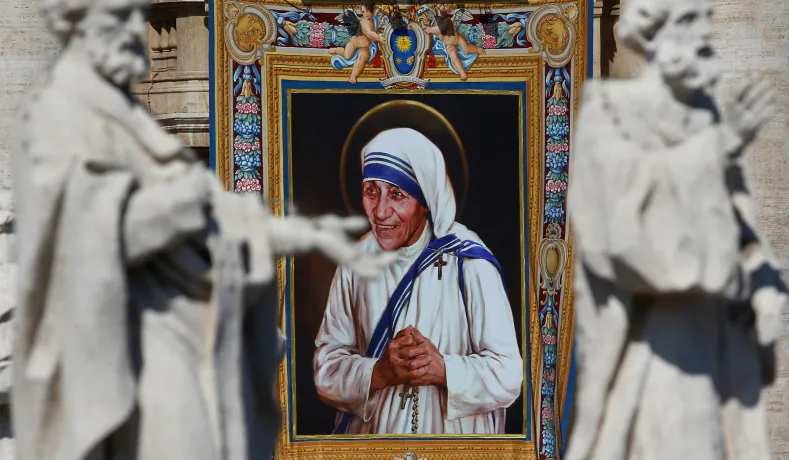
Editor’s Note: The following piece was originally published in National Review.
September 4, 2026
By Jim Towey
Ten years ago today, Mother Teresa of Calcutta was declared a saint by the Catholic Church. Her 50 years of compassionate care of the poorest of the poor and steadfast devotion to God attracted the admiration of the world and made such recognition a mere formality.
But while she has been enjoying the bliss of heaven, her detractors on earth are after her halo. A quick internet search with the question, “Was Mother Teresa a good person?” leads to a widely viewed video that purports to reveal the “hidden truth” about her and poses the question, “Was Mother Teresa a saint, or a monster?” (The podcaster unsurprisingly concluded she was the latter.) Another search result promised to “debunk the Mother Teresa myth.” Still another boasted, “Saint Mother Teresa was a documented mass murderer.” Not to be outdone, one contributor posted, “Mother Teresa was kind of a heartless b****.”
Trolling of celebrities can be expected in the highly competitive world of wannabe influencers, particularly if a revered public figure can be taken down. Younger audiences are ripe targets for such disinformation and defamation. Was Mother Teresa a hypocrite who befriended tyrants? Did she think it was good for the poor to suffer? Were the homes she operated inhumane? Such false narratives about one of the greatest women of the 20th century often go unchallenged and raise doubts about who she actually was.
The gaslighting of Mother Teresa’s historic achievements is prevalent in her adopted homeland of India, where she became a citizen at the outset of her work in the slums. She once showed me her diplomat’s passport and spoke with pride about officially traveling on the country’s behalf. And although she remains widely respected throughout the country, she is remembered more as a great humanitarian, if not a Hindu deity, than as a Christian missionary.
This should surprise no one. Mother Teresa’s relationship with her beloved India was always a delicate arrangement. As a member of a religious minority, she went to great lengths to avoid sectarian strife. She said she loved all religions but was in love with her own. But times have changed. India may be falling out of love with her and her sisters who now carry on with the work she began. The ascendance of Hindu nationalism and populist politics that began around the time of Mother Teresa’s canonization has made the tightrope that she and her Missionaries of Charity (MC) nuns walked even tighter.
Consider the case of 61-year-old Sister Concelia, who was arrested in the state of Jharkhand two years after Mother Teresa’s canonization and falsely accused of selling babies at the MC orphanage she led. Ranchi police proceeded to raid 17 MC missions and close down a home where the MCs cared for 24 abandoned babies. This frail nun spent 14 long months in jail before she was permitted bail. Only two months ago — eight years after her arrest — did Indian authorities dismiss the trumped-up charges brought against Sister Concelia. The jailing of Sister Concelia was followed a few years later by a central government effort to prohibit the MCs from receiving foreign donations, effectively starving them of funds. The outcry and public relations disaster that ensued forced the government to quickly rescind its decree.
When such trials arise, the MCs refrain from any public protest, just as Mother Teresa advised during her life. They keep their heads bowed and their hands busy feeding the hungry and clothing the poor in the 750 missions they operate in 138 countries, all without charge to anyone.
Try as they might, the MCs often can’t escape political persecution and danger. Six months before their foundress became a saint, four were martyred by Islamic terrorists in Yemen. In 2022, 18 MC nuns were expelled from Nicaragua by the government of Daniel Ortega as part of his campaign to banish the Catholic faith from the country. In Haiti not long ago, the MC convent and clinic were ransacked by gangs and burned to the ground. The sisters in Gaza, Ukraine, South Sudan, and Syria also are under fire, sometimes literally.
The grit and grace demonstrated by the nuns who follow in her footsteps were distinct traits of Mother Teresa. Her detractors conveniently forget that this tiny woman survived five heart attacks, dozens of bouts with malaria, and even a plane crash in Tanzania, not to mention decades of painful spiritual darkness, to build up the kingdom of God.
Nonetheless, Mother Teresa’s name, reputation, and missionary order remain under constant attack. Who will defend her memory and legacy from continued distortion? Next year will be the 30th anniversary of her death. Those of us who witnessed her beauty and experienced the life-changing impact she had on so many lives are aging out.
The Vatican will protect her rightful place in church history, but the public square is different from Saint Peter’s Square. Whether Mother Teresa will be venerated as a saint, or canceled as a monster, remains for future generations to decide.