

The Architects of Suicide-Affirming Care
Dangerous ideas lead to deadly practices
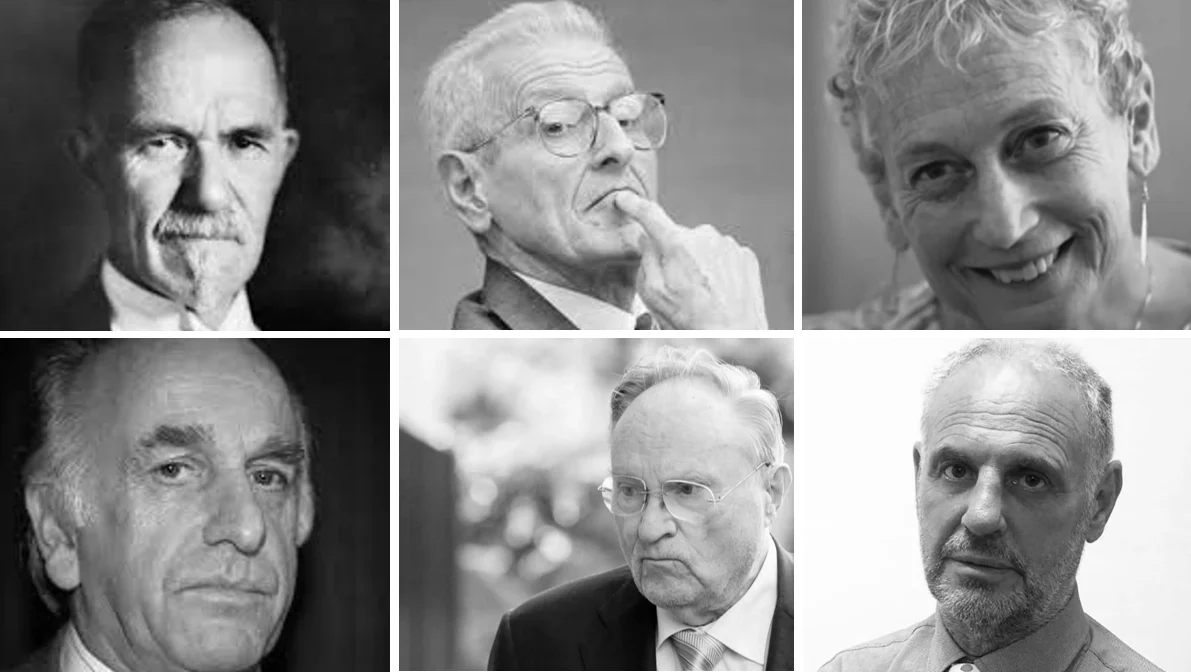
(Editor’s note: for best viewing experience, please view the PDF which includes photos of the individuals and a more engaging format.)
Every human is born with inherent dignity, regardless of health, wealth, race, or creed. This dignity does not diminish during times of serious illness or in the face of death. In the words of Mother Teresa of Calcutta, the need of every person is “to love and be loved.”
Resources like advance care planning and timely hospice admissions and palliative care respect human dignity and provide a hopeful vision for the future. Unfortunately, for decades, radical individuals have undermined these common-sense principles by marginalizing and endangering the poor, disabled, sick, and elderly through assisted suicide. America can only reckon with this dangerous idea once it understands the ideology that cheapens human dignity. The following individuals are the architects of this movement toward suicide-affirming care.
Samuel D. Williams (Euthanasia, 1870)
Samuel D. Williams, an English school teacher in the 1870s, was the first advocate for euthanasia in the modern era. Williams is credited with bringing the topic into the public square through his landmark essay, simply titled Euthanasia, where he rebranded the term from “a good natural death” into an act of mercy killing. The essay contained many of the same arguments used to push assisted suicide today such as it being a form of palliative care. Williams was a believer in social Darwinism, the pseudoscientific notion that the strongest and wealthiest in society are evolutionarily superior to those who are weak or poor. [i] This espousal of social Darwinism dramatically influenced the embrace of euthanasia by himself and those influenced by his writings.
Charles Davenport (1866 – 1944)
Charles Davenport was responsible for popularizing the idea of eugenics in the early 20th century, an idea which argued for the “compassionate” killing of those who were deemed unfit and considered “burdens on society.” Davenport’s research, which was funded in part by the Rockefeller Foundation, attempted to establish forced sterilization, selective procreation, and other ideas stemming from eugenics. In fact, the Nazi Aktion T4 program that was responsible for euthanizing over 70,000 people before and during World War II cited Davenport’s work as a deep influence.[ii] The eugenics movement fell out of favor in elite society after the Nuremberg trials laid bare the horrors of the Holocaust, but modern argument in favor of euthanasia and physician-assisted suicide draws on arguments related to quality-of-life, removing financial or emotional burdens, physicians as arbiters of what merits death, the undesirableness of disability, and heavy-handed government policy – all of which featured heavily in Davenport’s work.[iii]
Killick Millard (1870 – 1952)
Killick Millard was the founder of the Voluntary Euthanasia Legalisation Society (VELS) in England, now known as Dying in Dignity, and was as a prominent advocate for eugenics.[iv] Millard saw those whom he determined were “feeble minded” as a strain on society’s resources, and favored euthanizing such people, voluntarily or involuntarily. He is almost single handedly responsible for the birth and growth of the euthanasia movement in the United Kingdom. He presented multiple pro-euthanasia bills to Parliament in the early 20th century. Millard also advocated for the British government to release a Nazi doctor guilty of euthanizing people held in concentration camps by gasoline injection, claiming that such practices were “mercy killings.”[v]
Jack Kevorkian (1928 – 2011)
Known as “Dr. Death,” Michigan-based Jack Kevorkian was responsible for the deaths of at least 130 people within a 10-year span, most of whom were not terminally ill. Over 70% of his victims were women, causing many to speculate that he preyed on vulnerable women.[vi] Kevorkian is the most well-known advocate in the 20th century for a doctor’s ability to euthanize a patient, regardless of diagnosis, and even pushed for experimenting on condemned prisoners. After multiple criminal trials for his actions, he was finally convicted of second degree murder in 1999 where he filmed himself killing a man diagnosed with ALS and was sentenced to 10 years in prison.[vii] The recording of this killing was broadcast across the nation on an episode of 60 Minutes.
Derek Humphry (1930 – 2025)
The father of the assisted suicide movement in the United States, Derek Humphry founded the Hemlock Society (now Compassion and Choices) in 1980. He sparked media attention with his books Jean’s Way, where he revealed how he helped his wife kill herself, and Final Exit, a step-by-step guide on how to take one’s own life using a variety of methods. Humphry was responsible for assisting multiple people in their suicides, most notably the parents of his second wife, Ann Wickett Humphry. Ann herself later claimed that he tried to manipulate her into taking her own life after she had been diagnosed with breast cancer.[viii] When his efforts proved unsuccessful, he divorced her and immediately remarried. Ann would tragically take her life only a few years later, leaving a letter addressed to Derek that stated, “There. You got what you wanted.”
Ludwig Minelli (1932 – 2025)
Swiss lawyer Ludwig Minelli founded Dignitas, the world’s most well-known euthanasia center, in 1998. Dignitas has been responsible for the deaths of thousands of people across the world and was the center of an investigation after dozens of urns containing human ashes were found at the bottom of a lake near Dignitas headquarters.[ix] Minelli’s work at Dignitas also turned him into a multi-millionaire after being penniless when the organization was founded. He was accused by a former employee of pawning off deceased clients belongings.[x]
Philip Nitschke (1947 – Present)
Philip Nitschke is the founder of Exit International and the inventor of the “Sarco Pod,” a one-person gas chamber that uses nitrogen gas to kill its user. Nitschke is an outspoken advocate for suicide, regardless of whether a person is suffering from any illness, and has advised multiple people on how to commit suicide instead of seeking psychiatric help. His “Sarco Pod” was responsible for the death of a Missouri woman who, while using the death chamber, experienced severe cramping and was found by Swiss police with strangulation marks around her neck.[xi] Other suicide contraptions he invented include a “deliverance machine” which kills the user with nitrogen, as well as a barbiturate “testing kit.”
Ellen Wiebe (1952 – Present)
Ellen Wiebe is the most well-known euthanasia physician in Canada, taking credit for over 400 euthanasia deaths under Canada’s Medical Aid in Dying (MAiD) laws, many of which likely did not meet statutory qualifications. In fact, there are multiple recorded cases of Wiebe qualifying patients for MAiD that had been deemed ineligible by previous physicians.[xii] In one such case, Wiebe euthanized a man who was on a psychiatric day pass which prompted the man’s family to seek wrongful death charges. In another case, she snuck into a Jewish nursing home that enforced a strict policy against euthanasia, and killed one of the patients. She has yet to face any professional or criminal charges. Wiebe is also in favor of offering euthanasia as a remedy for the current housing crisis in Canada, saying “In some situations, I will actually ask: ‘If you could have better housing, if you could have better services, would you want to live longer?’ And you know, some would say, ‘yes’… Does that mean that person should not have rights? No. They should still have the right to make this decision [to be killed by euthanasia].”[xiii]
[i] Smith, Wesley J. “Life Unworthy of Life.” Discovery Institute, 1 Aug. 2006, www.discovery.org/a/3671/
[ii] “Charles Davenport.” Wikipedia, Wikimedia Foundation, en.wikipedia.org/wiki/Charles_Davenport
[iii] “The Eugenics Crusade,” Public Broadcasting Service, 16 Oct. 2018, www.pbs.org/wgbh/americanexperience/films/eugenics-crusade/
[iv] “Killick Millard.” Wikipedia, Wikimedia Foundation, en.wikipedia.org/wiki/Killick_Millard
[v] Hitchens, Dan. “Touching the Assisted Suicide Void.” First Things, 23 June 2025, www.firstthings.com/touching-the-assisted-suicide-void/
[vi] Dowbiggin, Ian. “A Concise History of Euthanasia: Life, Death, God, and Medicine.” Rowman & Littlefield, 2005.
[vii] Charatan, Fred. “Dr Kevorkian Found Guilty of Second Degree Murder.” British Medical Journal, 10 Apr. 1999, pmc.ncbi.nlm.nih.gov/articles/PMC1174693/
[viii] Abrams, Garry. “A Bitter Legacy: Angry Accusations Abound after the Suicide of Hemlock Society Co-Founder Ann Humphry.” Los Angeles Times, 23 Oct. 1991, www.latimes.com/archives/la-xpm-1991-10-23-vw-283-story.html
[ix] Klapper, Bradley. “Urns with Human Ashes Show up in Swiss Lake.” NBC News, 28 Apr. 2010, www.nbcnews.com/id/wbna36830363
[x] Williams, Alexandra. “The Penniless Founder of Dignitas ‘Now a Multi-Millionaire.’” Daily Mail, 24 June 2010, www.dailymail.co.uk/news/article-1289217/Dignitas-founder-Ludwig-Minelli-multi-millionaire.html
[xi] Land, Olivia. “‘immune-Compromised’ Woman, 64, Uses ‘Suicide Pod’ Dubbed ‘the Tesla of Euthanasia’ to End Her Life – Several Arrested.” New York Post, 24 Sept. 2024, www.nypost.com/2024/09/24/world-news/suicide-pod-used-for-first-time-by-64-year-old-us-woman-leading-to-arrests/
[xii] Schadenberg, Alex. “Ellen Wiebe.” Euthanasia Prevention Coalition, www.alexschadenberg.blogspot.com/search/label/Dr%20Ellen%20Wiebe
[xiii] Flanders, Nancy. “Canadian Doctor Says Housing Issues Justify Assisted Suicide.” Live Action, 12 Sept. 2025, www.liveaction.org/news/canadian-doctor-housing-issues-justify-assisted-suicide?queryID=2e52da667aca1b6eece66b88560e9cb1