

The Champions of End-of-Life Care
The men and women who paved the way for the care we see today
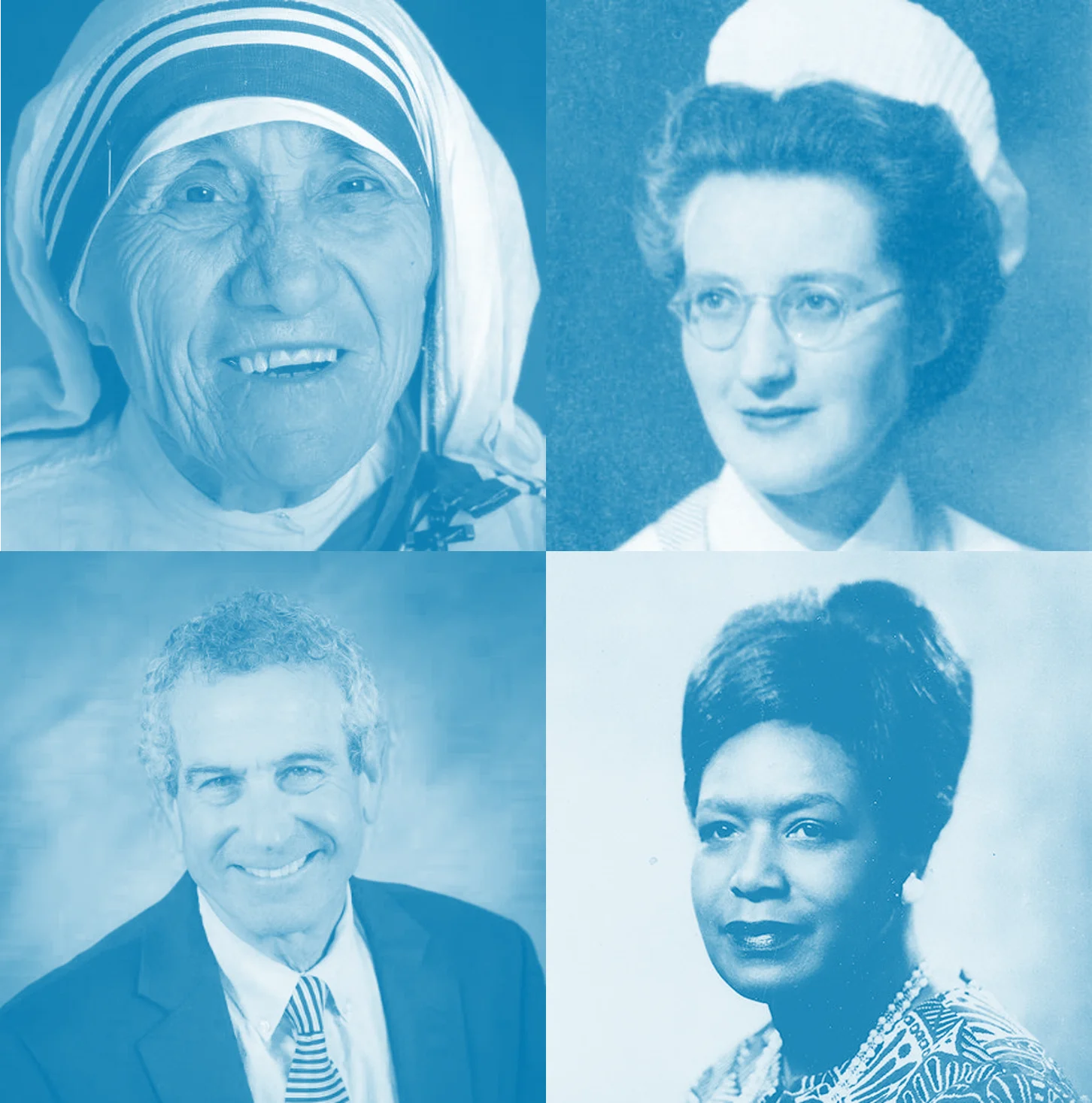
(Editor’s note: for best viewing experience, please view the PDF which includes photos of the individuals and a more engaging format.)
Every person deserves access to compassionate care at life’s end that meets their medical, emotional, and spiritual needs. Today, we live in an age where this care exists and is available to many. For our part, Aging with Dignity has helped over 43 million Americans and their families find peace during this time through our Five Wishes advance care planning program. However, we did not get to this point overnight.
We stand on the shoulders of giants whose contributions to medicine, ethics, and society transformed the world for the better. While their vision of a hopeful and peaceful death for all remains a work in progress, these champions of end-of-life care are an inspiration for all of us as we face the challenges and threats posed by the 21st century. By their example, we can create a world where aging is a blessing, humans come first, and everyone can finish life with confidence.
Mother Teresa of Calcutta (1910 – 1997)
Mother Teresa of Calcutta was a Catholic nun and missionary in India during the latter half of the 20th century, and founder of the Missionaries of Charity.[1] Albanian by birth, Mother Teresa joined the Catholic Sisters of Loreto in Ireland at the age of 18 and was sent to Calcutta to teach at an all-girls school. On September 10, 1946, she received a calling from God to start the Missionaries of Charity to serve the poorest of the poor in the streets of Calcutta.[2] Influenced by her time attending to the elderly, disabled, and poor in their hour of need, she remarked, “The greatest disease in the West today is not TB (tuberculosis) or leprosy; it is being unwanted, unloved, and uncared for.” Though she and her companions were not always equipped with high-end medical treatments, her ability to bring comfort to the dying by taking care of their physical, emotional, and spiritual needs proved that a good death depends on far more than medical intervention. By the time of her death, the Missionaries of Charity had expanded to almost four thousand members and were present in over 120 countries. Mother was the inspiration for the founding of Aging with Dignity, writing a letter to Jim Towey in 1996 asking him to take care of the elderly and poor. In 2016, she was canonized a saint in the Catholic Church.[3]
Dame Cicely Saunders (1918 – 2005)
Dame Cicely Saunders was the founder of the modern hospice movement and an advocate for holistic treatment at the end of life.[4] As a young woman, Saunders’ role as a nurse and social worker brought her to the bedside of many dying patients where she witnessed a system that characterized these individuals as diseases in need of a cure, not humans in need of care. This inspired her to pursue pain management methods that addressed both physical and mental suffering because for Saunders, “You matter because you are you, and you matter to the last moment of your life. We [should] do all we can not only to help you die peacefully, but also to live until you die.”[5] In 1967 she founded St. Christopher’s Hospice in London, which is still in use today, and was awarded over 20 honorary degrees and numerous awards for her work.[6]
Florence Wald (1917 – 2008)
Florence Wald, an American nurse, is considered the mother of the American hospice movement.[7] After visiting Dame Cicely Saunders’ St. Christopher’s Hospice in London, Wald was inspired by her holistic approach to end-of-life care and was determined to bring something similar to the United States. She founded Connecticut Hospice in 1974 with the help of some doctors, nurses, and clergy, making it the first of its kind in the United States. Wald emphasized providing holistic care and ensured the patient, their family, and their caregivers were given the support they needed. This provided a great deal of comfort to those suffering from aggressive diseases such as cancer and AIDS. Connecticut Hospice, which remains active today, was established on what Wald considered the 10 Principles of Care, which include regarding the patient and their family as a single unit, and accepting patients on the basis of health needs, not the ability to pay.[8]
Dr. Robert Twycross (1941 – 2024)
Dr. Robert Twycross was a physician, teacher, and author who played an integral role in the development of palliative and hospice care.[9] Another follower of Dame Cicely Saunders, Twycross joined her at St. Christopher Hospice to help with research on pain management drugs. His studies on the effects of regularly administered morphine to cancer patients was so influential that the World Health Organization added it to their guide on managing cancer pain.[10] Like Saunders, he was an outspoken advocate for better care at the end of life and developed a palliative care service at Sir Michael Sobell House hospice in Oxford. He also establish hospice care services in multiple countries and educated others on the benefits of hospice care on an international scale. He ardently spoke out against the legalization of physician-assisted suicide because of the inherent harm it poses to the development of effective hospice and palliative care, as well as its danger to the vulnerable of society.[11]
Dr. Bernice Catherine Harper (1922 – 2024)
Dr. Bernice Catherine Harper was a pioneer of social work and hospice care in the 20th century. She was the first African American woman to be admitted to USC’s social work master’s program and was known for her work on how health professionals can better cope with the stress of witnessing death.[12] Her expertise in social work was influential in the formation of health care policy at the state and federal level and her experiences with cancer patients and their families helped to foster her interest in the needs of patients with severe illnesses at the end of life. In fact, Harper’s impact on these fronts were crucial in incorporating hospice benefits into Medicare.[13] She helped advance hospice in sub-Saharan Africa by helping start a hospice foundation which now spans 15 countries, and she served as the chair of the National Hospice Organization Task Force on Access to Hospice Care by Minority Groups which focused on bringing hospice care to many of society’s underrepresented groups.[14]
Rita Marker (1940 – 2024)
Rita Marker was an author, lawyer, and pioneer in the fight against assisted suicide.[15] After attending a “right-to-die” conference in 1984, she was so horrified by the topics discussed that it compelled her to start her own anti-assisted suicide organization, the Patients Rights Council, to protect the rights of the disabled, poor, and elderly at the end of life.[16] She preached that the best way to effectively fight against the scourge of physician-assisted suicide and euthanasia was not only to show why these practices harmed society, but also to show people the resources and assistance that were available at the end of life and during times of serious illness. Her work as a public advocate for better end of life care brought her to over a dozen countries and almost every continent. When speaking on Rita, her former coworker Jason Negri said, “In the field of end-of-life issues, Rita was a legend. She pioneered and perfected effective opposition to assisted suicide and deserves credit for many victories on behalf of the medically vulnerable over the past 30 years.”[17]
Diane Coleman (1953 – 2024)
Diane Coleman was a disability rights advocate who founded the disability rights and anti-assisted suicide organization Not Dead Yet.[18] In her opinion, assisted suicide was a way for society to write-off those who were sick, dying, or disabled instead of looking for better ways to care for them. She organized numerous protests against physician-assisted suicide legislation in the United States; her fearless advocacy for disability rights caused her to be arrested over 25 times! Though she was diagnosed with muscular spinal atrophy at a young age, she was living proof that she was not defined by her disability, receiving an undergraduate degree from the University of Illinois and a law and business degree from UCLA.[19] She was inducted into the NYS Disability Rights Hall of Fame Class of 2025, only a year after her death.[20]
Wesley J. Smith (1949 – Present)
Wesley J. Smith is a bioethicist and the most outspoken advocate against assisted suicide in the 21st century.[21] After Wesley’s friend Frances committed suicide in 1993 with the assistance of the pro-suicide Hemlock Society, he realized how coercive the assisted suicide movement is, especially to the vulnerable.[22] He also saw that people were in desperate need of guidance during times of serious illness and that without drastic action Western bioethics eventually would embrace physician-assisted suicide. As a former hospice volunteer, he frequently emphasizes the benefits of hospice and palliative care because he knows firsthand the comfort that it brings patients. Wesley has written multiple books and spoken extensively on how the assisted suicide movement contradicts human dignity and compassionate care at the end of life and was honored as a “Great Defender of Life” by the Human Life Foundation. He also has a recurring column in the National Review where he addresses these topics.[23]
Dr. Ira Byock (1951 – Present)
Dr. Ira Byock is one of the most influential palliative care physicians, authors, and public advocates for better end-of-life care of the 21st century. His book Dying Well: Peace and Possibilities at the End of Life, gives an image of hope at the end of life by telling stories of people who maintained well-being as they died.[24] The book also addresses the problem so many Americans suffering from “bad deaths” at a time when good pain management through palliative and hospice care is both accessible and achievable. Byock led the formation of Providence Health and Services’ Institute for Human Caring which seeks to provide holistic care to the seriously ill, elderly, and their families.[25] Byock denounces the legalization of physician-assisted suicide, stating, “Legalizing assisted suicide fixes nothing,” and, “The principle that doctors must not kill patients stands. Two moral wrongs don’t make a right.”
__________________________________________________________________________
[1] Mother Teresa Center. https://www.motherteresa.org/
[2] Ibid
[3] “Mother Teresa.” Aging with Dignity. agingwithdignity.org/inspired-by-mother-teresa/
[4] “Dame Cicely Saunders.” St Christopher’s Hospice. www.stchristophers.org.uk/about/damecicelysaunders/
[5] “The Story of Modern Hospice Care.” Hospice UK. www.hospiceuk.org/latest-from-hospice-uk/you-matter-because-you-are-you-story-modern-hospice-care
[6] St. Christopher’s. www.stchristophers.org.uk/
[7] “Florence Wald, Mother of Hospice in America.” Connecticut Hospice. www.hospice.com/florence-wald-mother-of-hospice-in-america/
[8] “History.” Connecticut Hospice. www.hospice.com/history/
[9] Minton, Michael. “Robert Twycross Obituary.” The Guardian. 14 Nov. 2024. www.theguardian.com/society/2024/nov/14/robert-twycross-obituary
[10] “WHO Guidelines for the Pharmacological and Radiotherapeutic Management of Cancer Pain in Adults and Adolescents.” World Health Organization. www.who.int/publications/i/item/9789241550390
[11] Twycross, Robert. “Assisted Dying: Principles, Possibilities, and Practicalities. An English Physician’s Perspective.” BMC Palliative Care. 13 Apr. 2024. www.pubmed.ncbi.nlm.nih.gov/38609945/
[12] Carroll, Michele. “Alumna Bernice Harper Turns 100, Blazed a Trail as USC Social Work’s First African American Female and out-of-State Student: News.” USC Suzanne Dworak-Peck School of Social Work. 24 Mar. 2022. www.dworakpeck.usc.edu/news/alumna-bernice-harper-turns-100-blazed-trail-usc-social-works-first-african-american-female
[13] “NHPCO’s Deib Award: Dr. Bernice Catherine Harper Trailblazer Award.” National Alliance for Care at Home. www.allianceforcareathome.org/resource/nhpcos-deib-award-dr-bernice-catherine-harper-trailblazer-award/
[14] Ibid
[15] Smith, Wesley J. “Rita Marker, the Great Anti-Assisted-Suicide Champion, Has Died at 83.” National Review. 1 Nov. 2024. www.nationalreview.com/corner/rita-marker-the-great-anti-assisted-suicide-champion-has-died-at-83/
[16] Patients Rights Council, www.patientsrightscouncil.org/site/
[17] McKeown, Jonah. “Rita Marker, Prolific Anti-Euthanasia Advocate, Dies at 83.” Catholic News Agency. 5 Nov. 2024. www.catholicnewsagency.com/news/260277/rita-marker-prolific-anti-euthanasia-advocate-dies-at-83
[18] Not Dead Yet, www.notdeadyet.org/
[19] Risen, Clay. “Diane Coleman, Fierce Foe of the Right-to-Die Movement, Dies at 71.” The New York Times. 20 Nov. 2024. www.nytimes.com/2024/11/20/us/diane-coleman-dead.html
[20] “2025 NYS Disability Rights Hall of Fame.” NYSILC. www.nysilc.org/hof
[21] “Wesley J. Smith.” Discovery Institute. www.discovery.org/p/smith/
[22] Smith, Wesley J. “The Whispers of Strangers.” Newsweek. 27 June 1993. www.newsweek.com/whispers-strangers-193804
[23] “Wesley J. Smith.” National Review. www.nationalreview.com/author/wesley-j-smith/
[24] Byock, Ira. “Dying Well: Peace and Possibilities at the End of Life.” Riverhead Books. 1999.
[25] Institute for Human Caring, www.instituteforhumancaring.org/